
JOSEPHINE TROTTER Press
‘My best work yet’: meet the older workers who won’t clock off
More and more people are proving that old age doesn’t have to mean putting your feet up
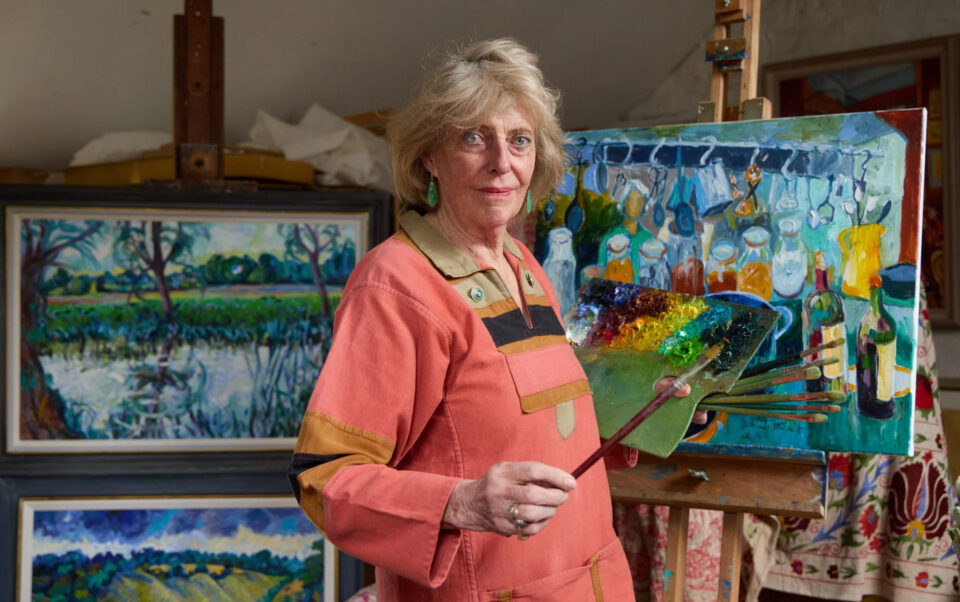
Josephine Trotter, 86, describes her work as the ‘romance’ of her life Credit: Matt Writtle
Josephine Trotter has just completed her 26th solo art exhibition. She exhibits once every three years, showing around 45 paintings each time.
Her “en plein air” landscapes and portraits – renowned for their vibrant colours and flowing curves – now fetch between £10,000 and £18,000 a piece, though prices vary.
“My expenses are enormous,” she notes. Collectors vie for her work.
Remarkably, Trotter is 86 years old. She is one of a growing number of citizens in their 70s and 80s who are simply refusing to retire.
Money is a nice perk, but for many, the prospect of endless hours watching daytime TV with their feet up is an appalling alternative to the stimulation that work gives them. So, they simply carry on.
Social interaction, routine, purpose and mental stimulation are frequently cited as the key reasons for their continuous graft. Even when the money being earned is substantial by most standards, it’s still not the driving force.
“Far from winding down, I think I am winding up and producing my best work now,” says Trotter, who lives in a rented barn in North Oxfordshire.
The intensity of work is important to her – she insists on each painting being completed in a single day.
Whenever she starts a new picture, she begins at seven or eight in the morning and works tirelessly throughout the day, with just a short break – often for an invigorating bottle of Guinness.
Her character is as colourful as her brushwork. Trotter’s signature is to depict joyfulness, so it is no surprise when she declares, simply: “I love life.”
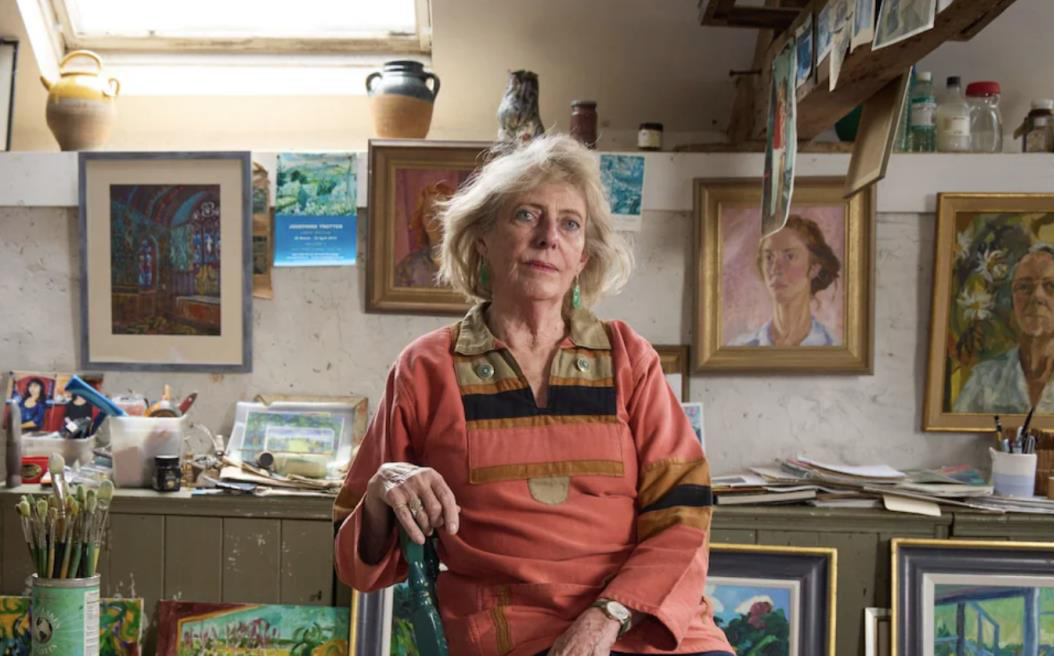
Josephine’s vivid artworks fetch up to £18,000 each Credit: Matt Writtle
Her guilty, not-so-secret secret is work. She doesn’t think of it as graft because it is the “romance” of her life.
Her late husband, to whom she was happily married for 50 years, was the other.
“Mentally, I need my work,” she says. “I follow all the artists I admire, attending their exhibitions. I can’t exist without my work or theirs.”
Even so, she admits that her last exhibition almost broke her. But the fire has been rekindled. “Thank the Lord, the inspiration returned. Onwards and upwards and off we go again.”
Extract from an article by Annie Hayes published in The Telegraph online, 1 June 2026
Country Life 18 January 2026
Josephine Trotter features in Country Life Magazine, read the article here.
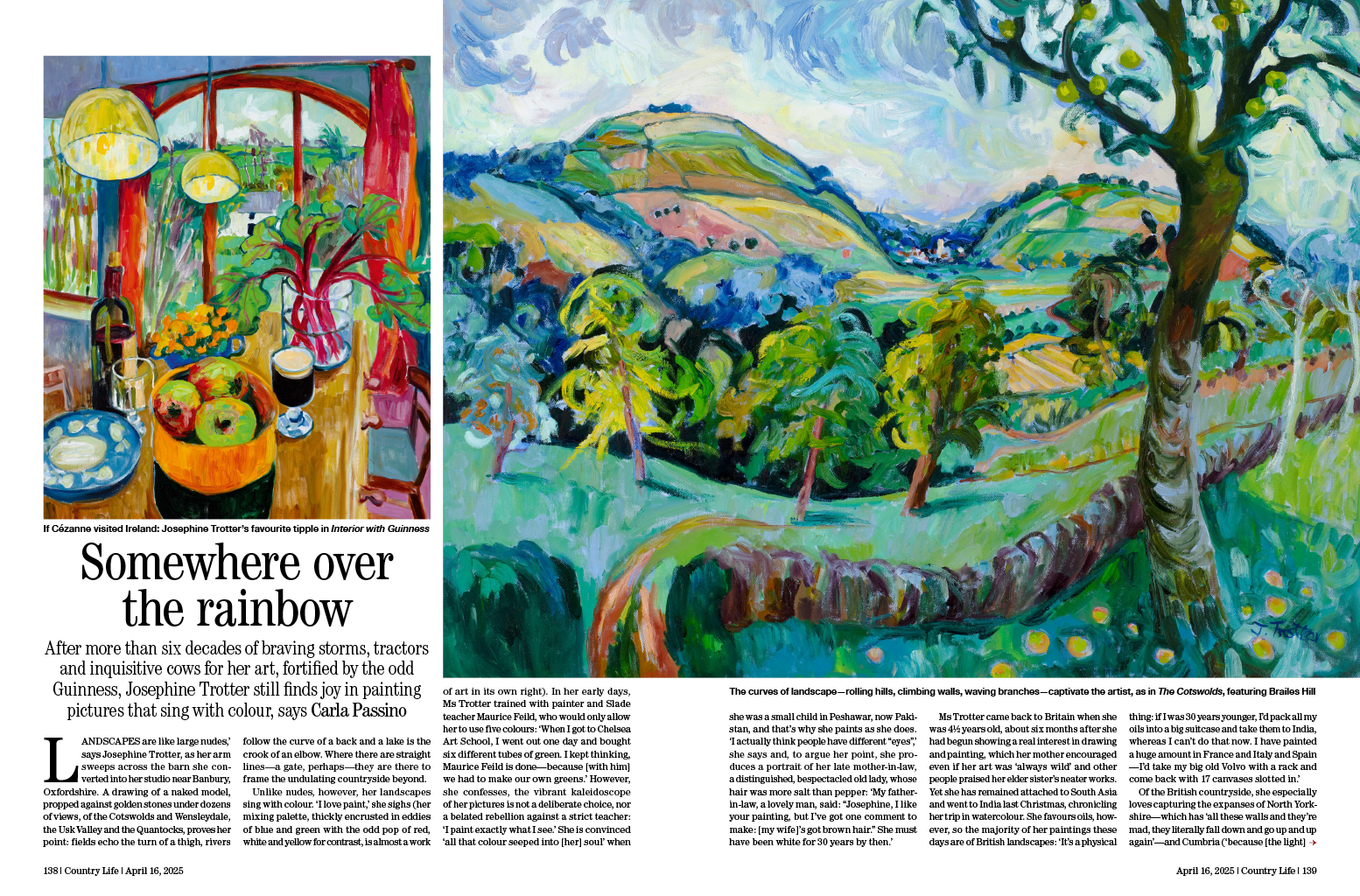
Josephine Trotter features in Country Life Magazine, to read the article download here.
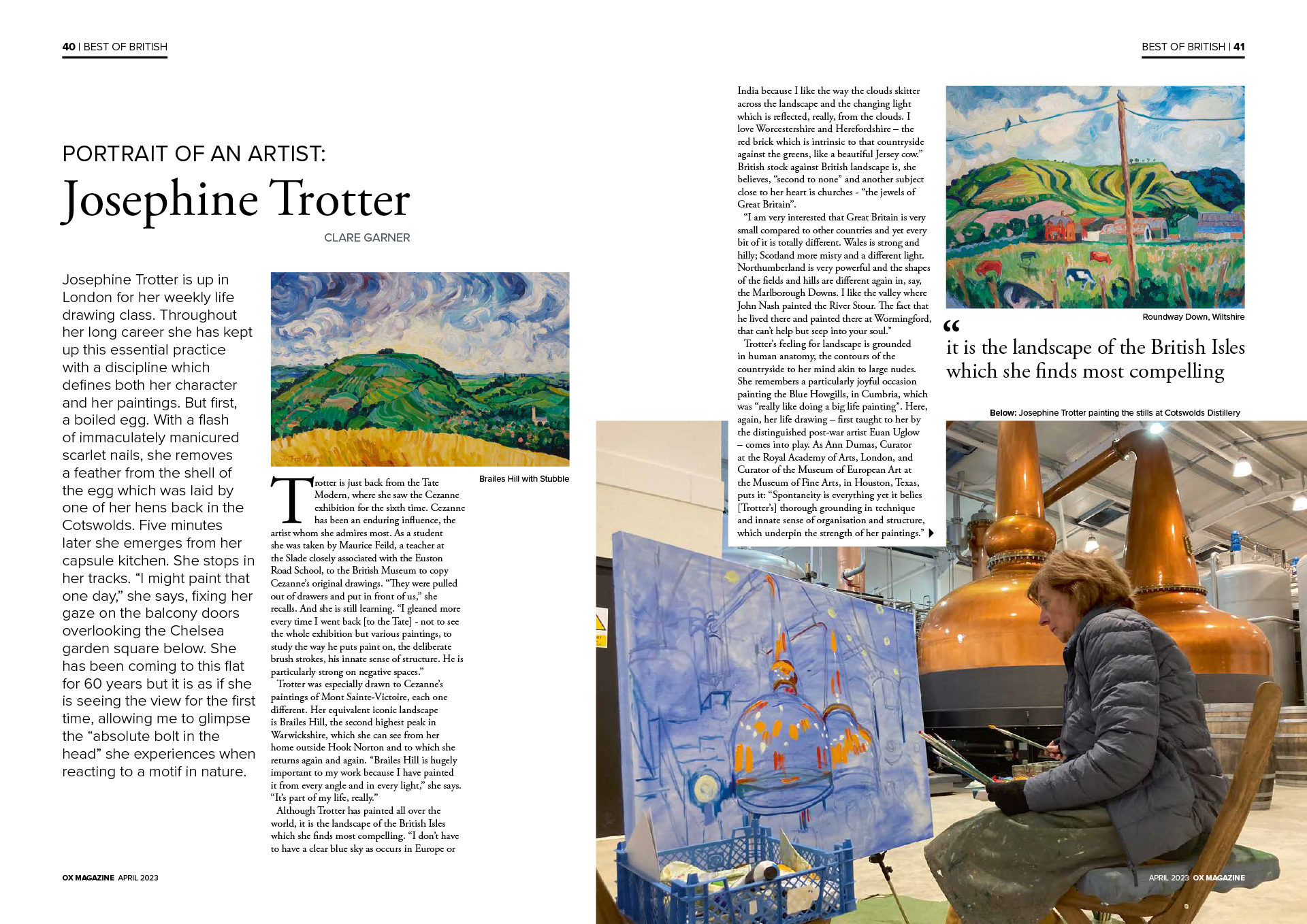
Josephine Trotter features in OX Magazine, to read the article download here.
JOSEPHINE TROTTER
25th Solo Exhibition
Review
Josephine Trotter’s most recent work shows an artist still at the height of her powers. The colours are vibrant, the brushwork fluid and strong, and the exuberance undimmed. This body of over 50 oil paintings produced in the last four years has lost none of its power to enchant.
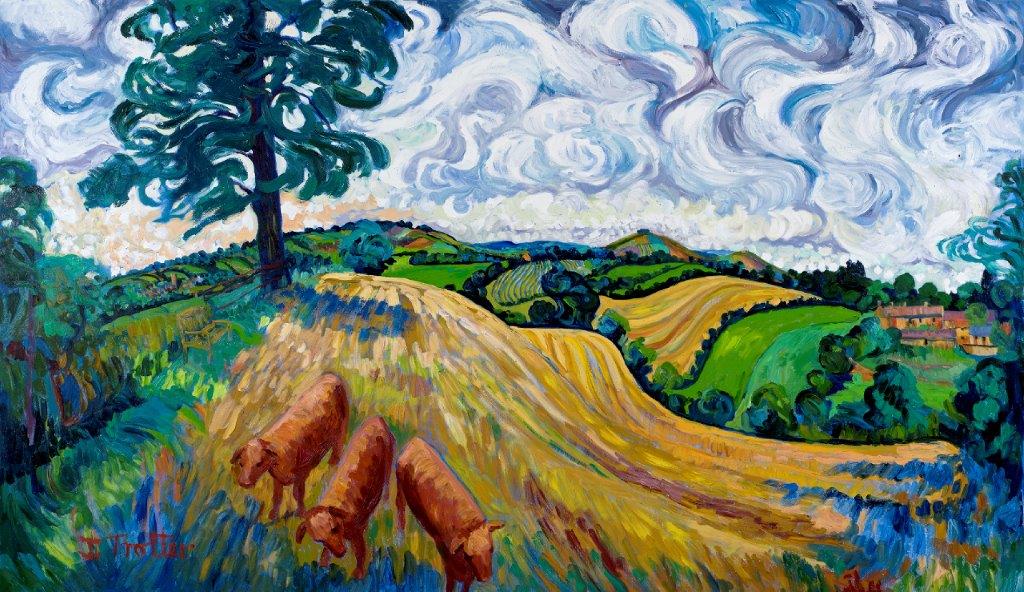
Trotter pursues the subjects that she has favoured during her long career – landscape and still life. Close to home, in paintings such as Brailes Hill, the rolling hills of Oxfordshire rise in a patchwork of greens, yellows and gold against billowing summer clouds, while in Cows at Nill Farm, the artist’s house nestles in the fold of a hill beneath a more threatening sky. Further afield, she has explored more dramatic scenery in Wales and the Usk Valley. In Cym Yoy, the proud, sombre profile of the mountains looms over a landscape that surges skywards, while a similar energy animates the undulating hills in Pen-y-Bryn.
Trotter’s ability to seize and distil her response to a motif in nature is perhaps her work’s most distinctive feature. She owes her love of landscape to her very early training. As a teenager, she took lessons with the painter Maurice Feild who taught at the Slade and who encouraged his pupils to work en plein air, following in Constable’s footsteps on Hampstead Heath and studying his oil sketches in the Victoria and Albert Museum. She reacts immediately and powerfully to a subject that she finds compelling. ‘I get an absolute bolt in the head’, she explains, adding ‘I can’t explain it – it’s very powerful.’ She paints landscapes on the spot in a single creative burst. She does no preparatory drawings and never uses photographs but draws in the broad outlines of the composition with thinly diluted paint. Spontaneity is everything yet it belies her thorough grounding in technique and innate sense of organisation and structure, which underpin the strength of her paintings. Her pigments, she explains, are always arranged in the same sequence on the palette, helping her to organise colour relationships on the canvas.
It was at Chelsea School of Art that Trotter really discovered colour. New paint ranges in tubes offered exhilarating possibilities – ‘at least five different greens’. Her brilliant manipulation of dazzling hues is abundantly present in her latest series of still lifes produced during studio lockdown. Lively patterned textiles and Persian rugs are backdrops to the fruits of the earth – burgeoning cape gooseberries, ranunculi or ‘tangled leeks’. The artist’s lifelong admiration for Matisse lies behind these colourful displays yet they are interpreted afresh through her own authentic vision. In Grace, a portrait of the artist’s granddaughter, the rapt attention of the cellist, contained in her private world of music, both accords and contrasts with the richness of the rug behind her. While in Early 1900s French Milk Jar with Rapture & Wright Backcloth softer tones of greeny-blue and yellow convey the texture of a piece of pottery that the artist has recently acquired.
Broadly speaking, Trotter is an artist working in the Post-Impressionist tradition, but her deeply felt, unmediated response to her subjects and her true understanding of the material quality of paint make her work personal and totally individual. Trotter is, without doubt, a painter in the truest sense of the word.
Ann Dumas
Curator, Royal Academy of Arts, London
Curator of European Art, Museum of Fine Arts, Houston, Texas
May 2022
“Josephine Trotter’s paintings may look direct and simple in the statement, but they are underpinned by disciplines long studied and hard won – disciplines of close observation, organisation and technical address, of light, space and form.”
William Packer
Art critic for the Financial Times since 1974
“Trotter is an artist who has a powerful feeling for the material she uses: oil paint, in all its glorious physicality. She says “I get so excited about paint, its quality & application. Also, I feel privileged to have trained at a time when drawing was the crux & bones of art education & very hard work. The thing is, I really love painting.” That is abundantly evident from her exuberant work.”
Martin Gayford
Art critic for the Daily Telegraph and author of The Yellow House & The Man in the Blue Scarf
“Trotter’s gift for distilling in her paintings that first ecstatic response to a scene brings to mind Van Gogh”
“Trotter’s latest work shows her at the height of her powers. She is an artist rooted in the tradition of modern Post- Impressionist painting but her deeply felt, poetic response to her native landscape brings a strong and totally individual vision to her subjects. She is a superlative painter in the truest sense of the word… In the end, her art is about the stuff of painting, and it is in the visceral essence of the material itself that she has always found herself and the reason why her paintings speak so vividly to us.”
Ann Dumas
Curator at the Royal Academy, including the recent blockbuster show “Picasso and Paper”
Curator of European Art, Museum of Fine Arts, Houston, Texas
“Full of movement, with swirling oils in bright colours, it’s contemporary art that will speak to those who enjoy the sensuality of paint, while those who appreciate the more pastoral end of British landscape painting will immediately relate to them, too.”
The Culture Whisper